Knowledge Base Software Guide for Better Business Success Today
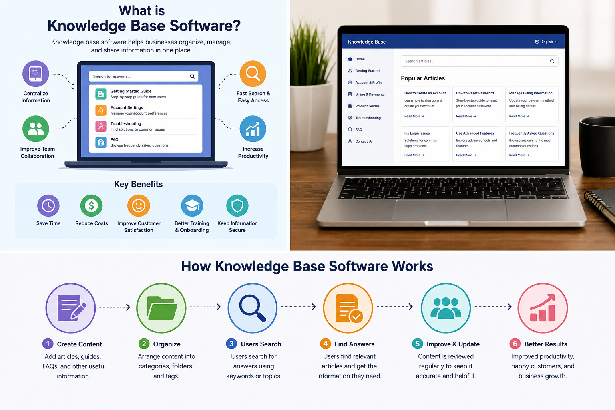
Knowledge base software is one of the smartest tools a business can use today. It stores important information in one place, making it easy for employees and customers to find answers. As a result, teams work faster, customers solve problems on their own, and companies save both time and money.
Whether you own a small business, manage a growing company, or lead a large organization, knowledge base software can improve daily work. Instead of answering the same questions again and again, your team can create helpful articles, guides, and tutorials that people can access anytime.
In this complete guide, you will learn everything about knowledge base software, including its features, benefits, types, examples, best practices, real-life uses, and expert advice. By the end, you will know how to choose the best solution for your business.
Table of Contents
What Is Knowledge Base Software?
Knowledge base software is a digital system that stores useful information in one organized place. It helps people quickly find answers without asking someone else.
For example, instead of emailing customer support, a customer can search the company’s knowledge base and find a step-by-step solution.
Similarly, employees can use it to learn company rules, training materials, or work instructions.
Think of it as a digital library that is always open.
Common information stored includes:
- User guides
- FAQs
- Product manuals
- Troubleshooting steps
- Company policies
- Training documents
- Video tutorials
- Checklists
Because everything stays organized, finding information becomes much easier.
Why Businesses Need Knowledge Base Software
Every business creates information every day. However, if information stays inside emails or people’s minds, it becomes difficult to find later.
This is where knowledge base software becomes valuable.
It helps businesses:
- Save employee time
- Reduce support tickets
- Improve customer satisfaction
- Keep information organized
- Train new employees faster
- Share company knowledge easily
- Reduce repeated questions
- Improve teamwork
For example, imagine a support team answering the same password reset question hundreds of times every month.
Instead, they can create one detailed article.
Now customers solve the problem themselves.
As a result, the support team focuses on bigger issues.
Everyone wins.
How Knowledge Base Software Works
The process is simple.
First, someone writes an article.
Next, the article gets organized into categories.
Then, users search for answers.
Finally, they find the information in seconds.
A typical workflow looks like this:
| Step | Action |
| Create | Write helpful content |
| Organize | Add categories and tags |
| Publish | Make articles available |
| Search | Users find answers |
| Update | Keep information current |
Most modern systems also include smart search features.
Therefore, users do not need the exact article title.
Instead, they simply type a few words.
The software finds the best answer automatically.
Types of Knowledge Base Software
Different businesses have different needs.
Because of that, there are several types of knowledge base software.
Internal Knowledge Base
Employees use this version.
It stores:
- HR documents
- Company rules
- Training materials
- Employee handbooks
- Process guides
Only authorized staff can access it.
External Knowledge Base
Customers use this version.
It includes:
- Help articles
- FAQs
- Product manuals
- Setup guides
- Troubleshooting instructions
Anyone can access it through the company’s website.
Hybrid Knowledge Base
Many companies combine both systems.
Employees see private information.
Customers see public articles.
This keeps sensitive data secure while offering excellent customer service.
Internal vs External Knowledge Bases
| Feature | Internal | External |
| Audience | Employees | Customers |
| Privacy | Private | Public |
| Content | Policies, training | FAQs, guides |
| Login Required | Yes | Usually No |
| Goal | Improve teamwork | Improve customer support |
Many successful companies use both.
Therefore, they improve both employee productivity and customer happiness.
Main Features of Knowledge Base Software
Good knowledge base software includes many helpful tools.
Let’s explore the most important ones.
Powerful Search
Search is the heart of every knowledge base.
Users should find answers in seconds.
A good search engine understands keywords, spelling mistakes, and related topics.
Categories
Articles stay organized.
For example:
Customer Support
- Billing
- Orders
- Shipping
Technical Help
- Installation
- Updates
- Errors
Account
- Login
- Password
- Security
Clear categories reduce confusion.
Tags
Tags connect similar articles.
For example:
- Windows
- Mac
- Android
- iPhone
- Payment
- Login
Therefore, users discover related information easily.
Rich Text Editor
Most systems include an editor similar to Microsoft Word.
Writers can add:
- Images
- Videos
- Links
- Tables
- Bullet lists
- Headings
As a result, articles become much easier to understand.
Version History
Sometimes mistakes happen.
Fortunately, version history saves every change.
Therefore, writers can restore older versions if needed.
User Permissions
Not everyone should edit articles.
Permission settings allow businesses to decide:
- Who can view
- Who can edit
- Who can publish
- Who can approve
This keeps information accurate.
Analytics
Analytics show:
- Most viewed articles
- Failed searches
- Popular topics
- Customer behavior
- Search trends
Therefore, companies know which articles need improvement.
Mobile Access
Many employees work remotely.
Because of that, mobile-friendly software is essential.
Users can find answers from:
- Phones
- Tablets
- Laptops
- Desktop computers
Benefits for Small Businesses
Small businesses often have limited staff.
Therefore, every minute matters.
Knowledge base software helps small businesses by saving valuable time.
Faster Customer Support
Customers solve simple problems themselves.
As a result, support teams answer fewer tickets.
Better Employee Training
Instead of repeating instructions, managers create one training guide.
New employees learn independently.
Consequently, onboarding becomes much faster.
Lower Costs
Hiring more support agents costs money.
However, a knowledge base reduces repetitive work.
Therefore, businesses spend less while serving more customers.
Consistent Answers
Every customer receives the same correct information.
This improves trust.
Better Organization
Instead of searching through emails, employees find everything in one place.
That saves hours every week.
Benefits for Large Companies
Large organizations manage thousands of documents.
Without organization, employees waste valuable time.
Fortunately, knowledge base software solves this problem.
Improved Collaboration
Different departments share information easily.
Marketing, HR, IT, and Sales all work together.
Faster Decision Making
Employees quickly find accurate information.
As a result, projects move faster.
Better Compliance
Many industries require proper documentation.
A knowledge base stores updated policies safely.
Global Team Support
International companies often have employees in different countries.
A cloud-based knowledge base gives everyone instant access.
Reduced Duplicate Work
Instead of creating the same document twice, employees reuse existing content.
Therefore, productivity increases.
Industries That Use Knowledge Base Software
Almost every industry benefits from knowledge base software.
Here are some examples.
Healthcare
Hospitals store:
- Medical procedures
- Staff guidelines
- Patient care protocols
Education
Schools organize:
- Course materials
- Student resources
- Teacher documents
Software Companies
Technology businesses publish:
- API documentation
- User manuals
- Developer guides
- Release notes
Retail
Retail businesses share:
- Product information
- Return policies
- Shipping instructions
Banking
Banks store:
- Compliance rules
- Security procedures
- Employee training
Manufacturing
Factories organize:
- Safety manuals
- Machine instructions
- Maintenance guides
Government
Public organizations publish:
- Citizen services
- Policies
- Legal documents
Why Customers Love Self-Service Support
Modern customers want quick answers.
They do not always want to wait for an email or phone call.
Because of that, knowledge base software has become very popular.
Customers enjoy self-service because it offers:
- Instant answers
- 24/7 availability
- Easy searching
- Clear instructions
- Helpful screenshots
- Step-by-step tutorials
- Video guides
- Faster problem solving
Imagine buying a new laptop. Instead of waiting for customer support, you search the help center, read a guide, and fix the issue within five minutes.
That creates a much better customer experience.
Knowledge Base Software Helps Teams Work Together
Every successful company depends on teamwork. However, teamwork becomes difficult when employees cannot find the information they need.
This is where knowledge base software makes a big difference.
Instead of asking coworkers the same questions every day, employees can search the knowledge base and find answers on their own.
For example:
- Sales teams can find pricing information.
- Marketing teams can check brand guidelines.
- HR teams can share employee policies.
- IT teams can publish troubleshooting guides.
- Managers can store project documents.
As a result, everyone spends less time searching and more time working.
Why Collaboration Improves
A shared knowledge base helps because:
- Everyone reads the same information.
- Teams avoid confusion.
- Employees make fewer mistakes.
- Communication becomes clearer.
- Projects move faster.
Consequently, businesses become more productive.
AI Is Changing Knowledge Base Software
Artificial Intelligence (AI) has improved knowledge base software in many ways.
Today, AI helps users find answers faster than ever before.
Instead of searching through dozens of articles, users receive the best answer almost instantly.
AI Features You Can Expect
Modern platforms often include:
- Smart search
- Auto-suggestions
- Content recommendations
- AI writing assistance
- Automatic article summaries
- Language translation
- Duplicate content detection
- Chatbot integration
Therefore, both employees and customers save valuable time.
Example
Imagine a customer types:
“I forgot my password.”
The AI understands the request even if the article title is:
“Reset Your Account Password”
The correct article appears immediately.
This creates a much smoother experience.
Organizing Articles Inside Knowledge Base Software
Even the best articles become useless if users cannot find them.
Therefore, organization matters just as much as writing.
A simple structure works best.
Example:
Home
Customer Support
Orders
Shipping
Returns
Payments
Products
Setup
Features
Updates
Troubleshooting
Company
Policies
Contact
Privacy
Terms
Users should reach any article within a few clicks.
Keep Categories Simple
Do not create dozens of confusing folders.
Instead:
✔ Use broad categories.
✔ Add smaller subcategories.
✔ Keep names short.
This makes navigation much easier.
Writing Great Articles for Knowledge Base Software
People visit a knowledge base because they need help.
Therefore, every article should solve one problem.
A helpful article includes:
- A clear title
- A short introduction
- Step-by-step instructions
- Images
- Videos if needed
- Tips
- Related articles
Example Layout
How to Reset Your Password
Step 1
Open the login page.
Step 2
Click “Forgot Password.”
Step 3
Enter your email.
Step 4
Check your inbox.
Step 5
Create a new password.
Done!
Simple instructions work best.
Search Optimization for Knowledge Base Software
Search is one of the most important features.
If users cannot find answers, they become frustrated.
Therefore, optimize every article.
Tips
Use clear titles.
Include common keywords.
Write naturally.
Add related terms.
Use short paragraphs.
Include bullet lists.
Add screenshots.
Update old articles.
These small improvements greatly increase search success.
Common Mistakes Businesses Make
Many companies create a knowledge base but forget to maintain it.
Eventually, users stop trusting it.
Avoid these mistakes.
Mistake 1
Outdated articles.
Always review content regularly.
Mistake 2
Poor search results.
Improve keywords and article titles.
Mistake 3
Long paragraphs.
People prefer short sections.
Mistake 4
Too many categories.
Simple navigation works better.
Mistake 5
Broken links.
Check links often.
Mistake 6
Missing screenshots.
Visual guides improve understanding.
Mistake 7
No updates.
Technology changes quickly.
Keep articles current.
Choosing the Right Knowledge Base Software
Every business has different needs.
Therefore, compare several options before making a decision.
Ask These Questions
Is it easy to use?
Can customers search quickly?
Does it support mobile devices?
Can employees edit together?
Does it include analytics?
Can it connect with help desk software?
Is cloud storage available?
Does it support AI?
Is pricing affordable?
Can it grow with your business?
If the answer is yes to most questions, the software may be a good choice.
Security Matters in Knowledge Base Software
Information is valuable.
Because of that, security should never be ignored.
Good systems include several protection features.
Important Security Features
Password protection
Two-factor authentication
Role-based permissions
Encrypted storage
Automatic backups
Access logs
Single Sign-On (SSO)
Secure cloud hosting
These features protect business information.
Example
An employee should not access payroll documents unless permission has been granted.
Permission controls make this possible.
How Knowledge Base Software Supports Remote Work
Remote work has become common.
However, remote employees often need quick answers.
Instead of sending emails, they can search the company knowledge base.
This improves productivity.
Remote Teams Benefit From
Training guides
Video tutorials
Company policies
Project documents
IT instructions
Meeting notes
Process documentation
Therefore, employees stay connected no matter where they work.
Measuring Success With Knowledge Base Software
After creating a knowledge base, businesses should measure its performance.
Fortunately, most systems include useful reports.
Important Metrics
| Metric | Why It Matters |
| Article Views | Shows popular content |
| Search Success Rate | Measures search quality |
| Failed Searches | Finds missing content |
| Customer Satisfaction | Measures helpfulness |
| Time Saved | Improves productivity |
| Support Tickets | Shows workload reduction |
| Article Ratings | Identifies useful guides |
| User Feedback | Helps improve content |
Review these numbers every month.
Then improve weak areas.
Real-Life Example: Small Business Success
A small online clothing store received over 300 customer emails every week.
Most questions were the same.
Customers asked about:
- Shipping
- Returns
- Size charts
- Delivery times
The owner created a simple knowledge base software system with helpful articles.
After three months:
- Customer emails dropped by 55%.
- Response times improved.
- Customers became happier.
- Employees saved several hours each week.
The business spent less time answering simple questions and more time growing.
Mini Case Study: Software Company
A software company launched a new app.
During the first month, the support team received thousands of questions.
Instead of hiring more agents, they built a complete knowledge base.
They added:
- Installation guides
- Video tutorials
- Troubleshooting articles
- Frequently asked questions
- Product updates
Within six months:
- Support tickets decreased by 42%.
- Customer satisfaction increased.
- New users learned the product faster.
- The support team focused on complex technical issues.
This shows how a well-organized knowledge base can improve both customer experience and business efficiency.
Expert Tips for Better Knowledge Base Content
Experts recommend following a few simple habits:
- Write for beginners first.
- Use short sentences and clear headings.
- Add screenshots whenever possible.
- Review articles on a regular schedule.
- Remove outdated information quickly.
- Link related articles together.
- Encourage feedback from users.
- Track search terms to discover missing topics.
- Use consistent formatting across all articles.
- Keep improving content based on analytics.
These practices help ensure your knowledge base software remains useful, accurate, and easy to navigate.
Knowledge Base Software Supports Business Growth
As a business grows, the amount of information grows too. New employees join, new products launch, and customer questions increase.
Without a proper system, information becomes scattered across emails, chat apps, and documents.
Knowledge base software keeps everything organized in one place.
Because of this, businesses grow without creating confusion.
Signs Your Business Needs a Larger Knowledge Base
- Customer questions are increasing.
- Employees ask the same questions every day.
- Training takes too much time.
- Important documents are hard to find.
- Different teams use different information.
If you notice these signs, expanding your knowledge base is a smart step.
Integrating Knowledge Base Software With Other Tools
A knowledge base works even better when it connects with other business software.
Instead of switching between many apps, employees can access everything from one system.
Common Integrations
- Customer Relationship Management (CRM)
- Help desk software
- Live chat
- Email support
- Project management tools
- Team messaging apps
- Learning management systems (LMS)
- Document storage platforms
These integrations reduce manual work and improve productivity.
Automation Makes Knowledge Base Software Even Better
Automation saves time by handling repetitive tasks.
For example, when a customer submits a support request, the system can automatically suggest related knowledge base articles.
If the article solves the problem, the customer does not need to contact support.
Useful Automation Features
- Automatic article suggestions
- Scheduled content reviews
- Content approval workflows
- Notifications for outdated articles
- Auto-tagging content
- Email recommendations
- Chatbot responses
As a result, businesses save both time and money.
Creating a Content Strategy for Knowledge Base Software
A successful knowledge base does not happen by accident.
Instead, it needs a clear content strategy.
Start With Common Questions
Look at:
- Customer emails
- Support tickets
- Live chat conversations
- Product reviews
- Social media questions
These sources reveal exactly what people want to know.
Then create articles that answer those questions.
Update Content Regularly
Information changes over time.
Therefore:
- Review articles every three months.
- Remove outdated information.
- Add new screenshots.
- Update product features.
- Fix broken links.
Fresh content builds trust.
Best Practices for Naming Articles
Article titles should be simple and clear.
Good titles help users find answers faster.
Good Examples
- How to Reset Your Password
- How to Change Your Email Address
- Fix Login Problems
- Update Billing Information
- Install the Mobile App
Poor Examples
- Important Information
- Read This First
- Helpful Guide
- Common Issues
Clear titles improve search results.
Building a User-Friendly Navigation System
People should never feel lost inside your knowledge base.
Keep navigation simple.
Example Structure
- Getting Started
- Account Settings
- Billing
- Products
- Troubleshooting
- Orders
- Returns
- Contact Support
Each category should contain only related articles.
This helps users find information quickly.
Encouraging Employees to Contribute
A knowledge base grows faster when everyone contributes.
Encourage employees to:
- Write new articles.
- Suggest updates.
- Report outdated information.
- Share useful tips.
- Add screenshots.
Reward helpful contributions.
This creates a culture of knowledge sharing.
Common Challenges When Using Knowledge Base Software
Even great systems have challenges.
Fortunately, most problems have simple solutions.
| Challenge | Solution |
| Outdated articles | Schedule regular reviews |
| Duplicate content | Merge similar articles |
| Poor search results | Improve keywords |
| Low employee participation | Offer training |
| Confusing navigation | Simplify categories |
| Broken links | Check links monthly |
| Missing images | Add screenshots |
| Inconsistent writing | Create style guidelines |
Planning ahead reduces these problems.
Scaling Knowledge Base Software as Your Company Grows
A small company may start with only 50 articles.
A large company may need thousands.
Therefore, scalability is important.
Tips for Scaling
- Use clear categories.
- Create content templates.
- Assign content owners.
- Archive outdated articles.
- Review analytics regularly.
- Train new writers.
- Standardize formatting.
These habits keep the knowledge base organized even as it grows.
The Future of Knowledge Base Software
Technology continues to evolve.
As a result, knowledge base software will become even smarter.
Future Trends
- More advanced AI assistants
- Voice search support
- Personalized content recommendations
- Better multilingual support
- Predictive search
- Improved analytics
- Enhanced mobile experiences
- Deeper chatbot integration
Businesses that adopt these features early can provide faster and better support.
Comparison Table: Traditional Support vs. Knowledge Base
| Feature | Traditional Support | Knowledge Base Software |
| Available 24/7 | No | Yes |
| Instant Answers | No | Yes |
| Handles Many Users at Once | Limited | Yes |
| Reduces Support Costs | No | Yes |
| Easy to Update | Moderate | Yes |
| Self-Service | No | Yes |
| Employee Training | Limited | Excellent |
| Search Function | No | Yes |
This comparison shows why many organizations invest in a modern knowledge base.
Real-Life Example: Growing SaaS Company
A software-as-a-service (SaaS) company expanded from 10 employees to 120 employees in two years.
At first, important information was stored in emails and shared folders.
As the company grew, employees struggled to find the latest procedures.
The company implemented knowledge base software and organized information into categories such as onboarding, product documentation, troubleshooting, and company policies.
After six months:
- New employee training time decreased by 35%.
- Internal support requests dropped significantly.
- Teams collaborated more effectively.
- Customer satisfaction improved because support agents had accurate information at their fingertips.
This example highlights how a well-managed knowledge base supports rapid business growth.
Expert Advice
Industry experts recommend treating your knowledge base as a living resource rather than a one-time project.
Here are a few practical suggestions:
- Assign owners for each content category.
- Review analytics every month.
- Encourage users to rate articles.
- Update guides after every product change.
- Write with simple language and short sentences.
- Test articles with new employees to ensure they are easy to understand.
Following these habits will help your knowledge base software remain valuable for years.
Plan Before You Launch Knowledge Base Software
A successful knowledge base begins with a good plan. Without planning, articles may become disorganized, incomplete, or outdated.
Start by asking a few important questions:
- Who will use the knowledge base?
- What information do they need most?
- Who will write the articles?
- Who will review the content?
- How often will articles be updated?
When you answer these questions early, your project has a much better chance of success.
Create Clear Goals
Your goals should be simple and measurable.
For example:
- Reduce customer support tickets by 30%.
- Shorten employee training time.
- Improve customer satisfaction.
- Increase self-service success.
- Keep company information organized.
These goals help you measure progress later.
Build a Strong Content Team
Even the best knowledge base software needs people who create and maintain content.
A small content team may include:
| Role | Responsibility |
| Content Writer | Creates articles |
| Editor | Reviews grammar and accuracy |
| Subject Expert | Confirms technical details |
| Administrator | Publishes and manages content |
| Support Agent | Suggests new topics |
When everyone understands their role, the knowledge base stays accurate and useful.
Create Content Templates
Templates help every article follow the same structure.
A simple template might include:
Title
Write a clear and specific title.
Problem
Explain what issue the article solves.
Solution
Give easy step-by-step instructions.
Tips
Share helpful advice.
Related Articles
Link to similar topics.
Last Updated
Show when the article was reviewed.
Templates make content easier to read and easier to maintain.
Migrate Existing Information Carefully
Many companies already have useful information stored in different places.
For example:
- Emails
- Word documents
- PDFs
- Shared folders
- Team chat messages
- Old websites
Before launching your new knowledge base software, gather this information and organize it.
Do not copy everything without reviewing it.
Instead:
- Remove outdated content.
- Delete duplicate articles.
- Correct mistakes.
- Update screenshots.
- Improve formatting.
A clean knowledge base is much easier to use.
Keep Content Accurate
People trust a knowledge base only when the information is correct.
Therefore, every article should have an owner.
The owner is responsible for:
- Reviewing updates
- Correcting mistakes
- Adding new information
- Removing outdated content
Regular reviews keep your knowledge base reliable.
Suggested Review Schedule
| Content Type | Review Frequency |
| Product Guides | Every month |
| Company Policies | Every 6 months |
| FAQ Articles | Every 3 months |
| Technical Documentation | After each update |
| Training Materials | Every quarter |
Following a schedule prevents outdated information from building up.
Improve Content With User Feedback
Your readers can help improve your knowledge base.
Add a simple question at the end of every article:
“Was this article helpful?”
Users can answer:
- Yes
- No
If many users click “No,” review the article.
You can also invite comments such as:
- What information was missing?
- Which step was confusing?
- What should we explain better?
This feedback helps you create better articles over time.
Measure the Return on Investment (ROI)
Businesses want to know if knowledge base software is worth the cost.
Fortunately, it is easy to measure results.
Common ROI Metrics
- Fewer support tickets
- Faster response times
- Lower training costs
- Higher customer satisfaction
- Better employee productivity
- Reduced onboarding time
- More self-service usage
Compare these numbers before and after launching your knowledge base.
If they improve, your investment is paying off.
Advantages of Knowledge Base Software
Every business can benefit from a well-managed knowledge base.
Main Advantages
- Information stays organized.
- Customers find answers quickly.
- Employees save time.
- Training becomes easier.
- Support costs decrease.
- Team collaboration improves.
- Knowledge remains available even when employees leave.
- Articles are available 24/7.
- Search makes information easy to find.
- Businesses grow more efficiently.
These benefits make a knowledge base valuable for companies of every size.
Disadvantages of Knowledge Base Software
Although the benefits are significant, there are also a few challenges.
Possible Disadvantages
- Initial setup takes time.
- Content requires regular updates.
- Employees need training.
- Poor organization causes confusion.
- Outdated articles reduce trust.
- Large knowledge bases require ongoing management.
Fortunately, good planning solves most of these problems.
Real-Life Example: Customer Support Improvement
A medium-sized electronics company received more than 1,000 support requests each month.
Most questions were about:
- Device setup
- Warranty information
- Software updates
- Product registration
The company created a public knowledge base with detailed guides and screenshots.
After six months:
- Support tickets dropped by 48%.
- Customers found answers much faster.
- Support agents focused on more complex issues.
- Customer satisfaction scores increased.
The company also reduced support costs without lowering service quality.
Case Study: Employee Onboarding
A growing marketing agency hired several new employees every month.
Managers spent many hours explaining the same procedures.
The agency built an internal knowledge base software system that included:
- Welcome guides
- HR policies
- Project workflows
- Software tutorials
- Frequently asked employee questions
Results after four months:
| Before | After |
| Two weeks of onboarding | One week of onboarding |
| Many repeated questions | Fewer repeated questions |
| Scattered documents | Organized information |
| Slow training | Faster learning |
This allowed managers to spend more time leading projects instead of repeating instructions.
Expert Advice for Long-Term Success
Knowledge management experts recommend treating your knowledge base as an ongoing project.
Here are some practical tips:
- Write in simple language.
- Use screenshots whenever possible.
- Keep articles short and focused.
- Review content regularly.
- Link related articles together.
- Track search terms to discover missing topics.
- Encourage employees to contribute.
- Celebrate improvements and milestones.
These habits help your knowledge base remain useful as your business grows.
Quick Checklist Before Publishing Articles
Use this checklist every time you publish new content:
- Clear title
- Short introduction
- Easy steps
- Images included
- Links tested
- Grammar checked
- Keywords added naturally
- Related articles linked
- Mobile-friendly formatting
- Review date added
A checklist helps maintain consistent quality across all articles.
Common Myths About Knowledge Base Software
Many people misunderstand what a knowledge base can do.
Here are a few common myths:
Myth 1: Only Large Companies Need It
Reality: Small businesses also save time and improve customer support.
Myth 2: It Replaces Customer Support
Reality: It reduces simple questions but still supports human agents.
Myth 3: It Never Needs Updates
Reality: Regular updates are essential to keep information accurate.
Myth 4: It Is Too Difficult to Build
Reality: Many modern platforms make setup simple with templates and drag-and-drop editors.
Understanding these myths helps businesses make informed decisions.
Final Tips Before Choosing Knowledge Base Software
Before selecting a platform, remember these key points:
- Choose software that is easy to use.
- Make sure search works well.
- Check mobile compatibility.
- Look for AI-powered features.
- Review security options.
- Compare pricing plans.
- Test integrations with your existing tools.
- Read customer reviews.
- Start with a small pilot project if possible.
Taking time to evaluate your options can save money and improve long-term success.
How to Choose the Best Knowledge Base Software
Not every business needs the same software.
A small business may want a simple and affordable solution. On the other hand, a large company may need advanced security, AI features, and many integrations.
Before choosing a platform, make a list of your needs.
Ask yourself:
- How many employees will use it?
- Will customers access it?
- Do you need multiple languages?
- Will remote teams use it?
- Do you need AI-powered search?
- Does your business expect rapid growth?
These answers will help you narrow your options.
Features You Should Never Ignore
Some features are optional, but others are essential.
Always look for:
- Fast search
- Mobile-friendly design
- Easy article editor
- Categories and tags
- User permissions
- Analytics dashboard
- Version history
- AI-powered search
- Content approval workflow
- Secure cloud storage
- Integration with help desk software
- API support
- Backup and recovery
- Custom branding
- Multi-language support
The more useful features you have, the easier it becomes to manage your knowledge base.
Comparison Table of Popular Knowledge Base Solutions
The following table compares common features you should evaluate when choosing knowledge base software. Instead of focusing on brand names, compare platforms based on what they offer.
| Feature | Basic Platform | Mid-Level Platform | Enterprise Platform |
| Search | Good | Excellent | AI Powered |
| Mobile Access | Yes | Yes | Yes |
| AI Features | Limited | Good | Advanced |
| Security | Standard | Strong | Enterprise Grade |
| Analytics | Basic | Detailed | Advanced |
| Workflow Approval | No | Yes | Yes |
| API Integration | Limited | Yes | Advanced |
| Multi-language | No | Yes | Yes |
| Custom Branding | Limited | Yes | Full |
| Scalability | Small Teams | Growing Business | Large Enterprise |
Choose the platform that matches your current needs while leaving room for future growth.
Best Practices for Growing Your Knowledge Base
A knowledge base should grow alongside your business.
Follow these habits:
- Add new articles every week.
- Update old articles regularly.
- Archive outdated content.
- Organize categories clearly.
- Monitor search analytics.
- Ask employees for suggestions.
- Review customer feedback.
- Link related articles together.
- Keep screenshots current.
- Use a consistent writing style.
Small improvements made regularly lead to a much stronger knowledge base over time.
Common Use Cases for Knowledge Base Software
Businesses use knowledge base software in many different ways.
Customer Support
Customers can find answers without contacting support.
Employee Training
New hires learn company processes faster.
IT Help Desk
Employees solve common technical issues independently.
Human Resources
HR teams publish policies, benefits information, and onboarding materials.
Product Documentation
Software companies provide installation guides, tutorials, and troubleshooting articles.
Sales Teams
Sales representatives quickly access pricing, product details, and proposal templates.
Operations
Operations teams document workflows and standard procedures.
These use cases show how flexible a knowledge base can be.
Real-Life Case Study: Online Education Company
An online education company offered hundreds of courses.
Students frequently asked the same questions about:
- Account setup
- Password recovery
- Course certificates
- Video playback
- Payment options
The company launched a public knowledge base with step-by-step guides and screenshots.
Results After Six Months
| Metric | Before | After |
| Weekly Support Tickets | 900 | 500 |
| Customer Satisfaction | 82% | 94% |
| Average Response Time | 18 Hours | 6 Hours |
| Self-Service Success | 40% | 76% |
Students found answers more quickly, and support staff handled more complex requests.
Real-Life Case Study: Manufacturing Business
A manufacturing company had hundreds of machine manuals stored in paper files.
Employees often spent valuable time searching for the correct instructions.
The company digitized all documentation using knowledge base software.
They organized content by:
- Machine type
- Maintenance schedules
- Safety procedures
- Repair instructions
- Spare parts
Benefits
- Faster maintenance
- Better workplace safety
- Fewer production delays
- Easier employee training
- Improved documentation
This project significantly improved daily operations.
Mistakes to Avoid When Expanding Your Knowledge Base
As your knowledge base grows, avoid these common mistakes:
- Publishing duplicate articles
- Ignoring user feedback
- Using inconsistent formatting
- Writing overly technical content
- Forgetting to review outdated information
- Creating too many categories
- Not assigning content owners
- Skipping analytics reviews
Avoiding these issues keeps your knowledge base easy to use.
Expert Recommendations
Knowledge management professionals suggest the following:
Write for Beginners
Assume readers have little prior knowledge.
Keep Articles Short
One article should solve one problem.
Use Images Often
Screenshots improve understanding.
Link Related Articles
Help readers continue learning.
Measure Performance
Use analytics to improve content.
Encourage Contributions
Employees often know valuable information that should be documented.
Buying Checklist for Knowledge Base Software
Before purchasing a platform, compare each option using this checklist.
| Question | Yes | No |
| Easy to Use | □ | □ |
| Fast Search | □ | □ |
| AI Features | □ | □ |
| Mobile Friendly | □ | □ |
| Secure Access | □ | □ |
| Analytics Included | □ | □ |
| Easy Integrations | □ | □ |
| Multi-language Support | □ | □ |
| Affordable Pricing | □ | □ |
| Can Scale With Business | □ | □ |
A simple checklist helps you make a confident decision.
Key Takeaways
By now, you have learned that knowledge base software is much more than a document library.
It helps businesses:
- Organize important information
- Improve customer support
- Train employees
- Save time
- Reduce costs
- Increase productivity
- Encourage teamwork
- Support remote employees
- Deliver better customer experiences
- Grow efficiently
A successful knowledge base depends on clear writing, regular updates, strong organization, and ongoing improvements.
Knowledge Base Software Guide for Better Business Success Today
Frequently Asked Questions (FAQs)
- What is knowledge base software?
Knowledge base software is a tool that stores information in one organized place. It allows employees and customers to search for answers, guides, tutorials, and company documents whenever they need them.
- Why is knowledge base software important?
It saves time, improves customer support, reduces repeated questions, helps employees learn faster, and keeps important information organized.
- Who should use knowledge base software?
Almost every organization can benefit, including:
- Small businesses
- Large companies
- Schools
- Hospitals
- Government offices
- Online stores
- Software companies
- Non-profit organizations
- What is the difference between an internal and an external knowledge base?
An internal knowledge base is only for employees and contains company information, training, and policies.
An external knowledge base is available to customers and includes help articles, FAQs, product guides, and troubleshooting instructions.
- Can small businesses benefit from knowledge base software?
Yes. Small businesses often save the most time because employees no longer answer the same questions repeatedly.
- Does knowledge base software reduce customer support tickets?
Yes. Many customers prefer finding answers themselves. A well-written knowledge base can significantly reduce repetitive support requests.
- Is knowledge base software difficult to use?
Most modern platforms are designed to be simple. Many include drag-and-drop editors, templates, and search tools that make content management easy.
- How often should articles be updated?
Review articles regularly. Product documentation may need monthly updates, while company policies can often be reviewed every six months.
- What types of content should be included?
A strong knowledge base can include:
- FAQs
- User guides
- Product manuals
- Troubleshooting articles
- Training documents
- Company policies
- Video tutorials
- Checklists
- Best practices
- Does AI improve knowledge base software?
Yes. AI helps users find answers faster, recommends articles, summarizes content, and supports chatbots with accurate information.
- Can knowledge base software support remote employees?
Yes. Remote employees can access company documents, training materials, and procedures from anywhere with an internet connection.
- How can I encourage employees to use the knowledge base?
Make it easy to search, keep articles up to date, provide useful content, and encourage staff to contribute improvements and new ideas.
- What security features should I look for?
Choose software that offers:
- Role-based permissions
- Two-factor authentication
- Data encryption
- Secure backups
- Activity logs
- Single Sign-On (SSO)
These features help protect sensitive information.
- How do I measure the success of a knowledge base?
Track important metrics such as:
- Article views
- Search success rate
- Customer satisfaction
- Support ticket reduction
- Employee productivity
- User feedback
Review these metrics regularly to identify areas for improvement.
- What are the biggest mistakes to avoid?
Avoid:
- Outdated articles
- Duplicate content
- Confusing categories
- Broken links
- Poor search optimization
- Inconsistent writing
- Ignoring user feedback
Regular maintenance prevents these problems.
- Can knowledge base software integrate with other business tools?
Yes. Many platforms integrate with:
- Help desk systems
- CRM software
- Team chat applications
- Project management tools
- Learning management systems
- Email platforms
Integrations improve workflow and reduce manual work.
- Is cloud-based knowledge base software better than on-premises software?
For many businesses, cloud-based solutions are easier to manage because they provide automatic updates, remote access, and simpler maintenance. However, organizations with strict security or compliance requirements may prefer on-premises deployments.
- How long does it take to build a knowledge base?
The timeline depends on the amount of content. A small knowledge base may take a few weeks, while a large enterprise project may require several months. Starting with the most common questions is often the best approach.
- What makes a great knowledge base article?
A high-quality article should have:
- A clear title
- A short introduction
- Step-by-step instructions
- Simple language
- Helpful screenshots
- Links to related articles
- Regular updates
Readers should solve their problem without needing additional help.
- How do I choose the best knowledge base software?
Compare platforms based on:
- Ease of use
- Search quality
- AI features
- Security
- Integrations
- Mobile support
- Analytics
- Scalability
- Pricing
- Customer support
Choose a solution that fits both your current needs and future growth.
Final Comparison Chart
| Feature | Basic Knowledge Base | Advanced Knowledge Base |
| Search | Basic keyword search | AI-powered smart search |
| Content Editor | Standard editor | Rich editor with templates |
| Analytics | Limited | Detailed reports and insights |
| Automation | Minimal | Advanced workflows |
| Security | Basic permissions | Enterprise-grade security |
| Integrations | Few | Extensive integrations |
| Scalability | Small teams | Businesses of all sizes |
| Mobile Support | Available | Optimized across devices |
| Collaboration | Limited | Real-time collaboration |
| Content Management | Manual | Automated tools and approvals |
Expert Advice
If you are creating a knowledge base for the first time, start small. Focus on the questions people ask most often. Then add new articles every week instead of trying to build everything at once.
Keep your writing simple, use screenshots whenever possible, and review your content regularly. Encourage employees and customers to provide feedback because their suggestions will help you improve the knowledge base over time.
Remember that knowledge base software is not a one-time project. It is a resource that grows with your business. The more care you put into it, the more value it will deliver.
Conclusion
Knowledge base software has become an essential tool for modern businesses. It helps organize information, improves customer support, reduces repetitive work, and makes employee training faster and easier. Whether you run a small startup or a large enterprise, a well-planned knowledge base can save time, lower costs, and improve productivity.
Success depends on more than choosing the right software. It also requires clear writing, regular updates, strong organization, and continuous improvement. By following the best practices in this guide, you can create a knowledge base that serves both your team and your customers for years to come.
As technology continues to evolve, AI-powered search, automation, and smarter content management will make knowledge base software even more valuable. Businesses that invest in a high-quality knowledge base today will be better prepared to meet customer expectations and support future growth.
External Resources
To learn more about knowledge management and documentation best practices, explore these trusted resources:
- https://www.iso.org (Knowledge management standards)
- https://developers.google.com/search (Google Search documentation and SEO guidance)
- https://learn.microsoft.com (Technical documentation and knowledge-sharing practices)
- https://www.atlassian.com (Guides on documentation, collaboration, and knowledge management)
- https://www.nngroup.com (Research on usability and user experience)