Business Networking Hampton Roads: A Complete Local Guide
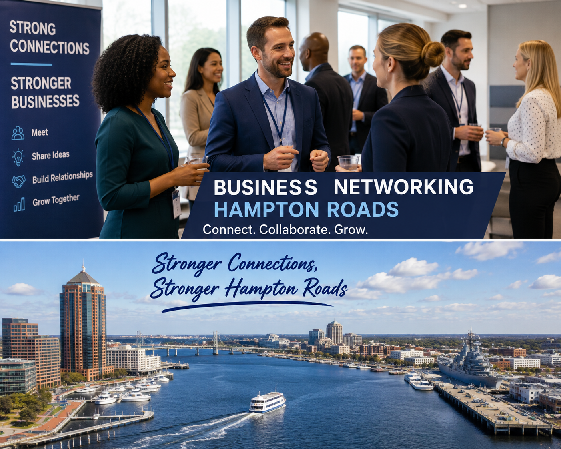
Business networking Hampton Roads can help a small business owner meet new people, find useful partners, learn from other owners, and discover new ways to grow. However, good networking is not about collecting hundreds of business cards. Instead, it is about building a small group of people who know you, trust you, and want to help you succeed.
Hampton Roads has a wide business community spread across cities such as Virginia Beach, Norfolk, Chesapeake, Portsmouth, Suffolk, Hampton, Newport News, and nearby areas. Because the region is large, networking can feel confusing at first. Fortunately, there are chambers, business groups, small-business programs, workshops, expos, professional events, and informal meetups that make it easier to connect.
The key is to choose the right events and show up with a clear plan.
This guide explains how to make business networking Hampton Roads work for you, whether you own a small shop, run a service company, work in technology, sell to other businesses, work in real estate, provide professional services, or are simply trying to build your career.
Table of Contents
What Business Networking Hampton Roads Really Means
Business networking Hampton Roads means creating professional relationships with people and organizations in the Hampton Roads region.
That definition sounds simple, but networking has several parts.
First, you meet people.
Next, you learn about their work.
Then, you find ways to help each other.
Over time, those small interactions can become referrals, partnerships, friendships, supplier relationships, customer relationships, job opportunities, or new ideas.
Good networking takes time. Therefore, you should not judge an event only by how many sales you make that night.
A person you meet today may introduce you to a customer six months later. Likewise, someone who cannot buy from you may know another person who needs your service.
That is why relationships matter.
Why Local Connections Matter
Local businesses often depend on trust.
For example, someone looking for a plumber, accountant, photographer, contractor, marketing company, lawyer, designer, realtor, or cleaning service may ask friends for recommendations.
People often prefer a recommendation from someone they know over a random advertisement.
Therefore, networking can help you become the person people remember when a need appears.
The local connection also gives you useful knowledge.
You may learn:
- Which events attract your customers
- Which organizations support small businesses
- Which companies need suppliers
- Where entrepreneurs meet
- What local customers want
- Which industries are growing
- How other business owners solve problems
- Where to find mentors
- How to improve your sales process
So, networking is not simply promotion. It is also learning.
Business Networking Hampton Roads for Beginners
If you are new to business networking Hampton Roads, do not try to attend every event.
That approach can waste time and money.
Instead, choose two or three types of events.
For example, you might attend:
- One chamber event each month
- One industry event each month
- One small-business workshop each month
This simple schedule gives you time to build relationships without overwhelming your calendar.
Also, attend the same events more than once.
Seeing the same people again makes conversations easier. You do not need to introduce yourself from zero every time.
A person may remember you after the second or third meeting.
Know Your Networking Goal First
Before attending any event, ask yourself one question:
What do I want to achieve?
Your answer could be:
- Find customers
- Meet suppliers
- Find business partners
- Learn about an industry
- Find a mentor
- Meet potential employees
- Build local brand awareness
- Learn about government contracts
- Find investors
- Meet other entrepreneurs
Your goal changes how you network.
For example, a new restaurant owner may want to meet local food suppliers and nearby business owners.
A technology company may want partnerships and government contacts.
A freelancer may want referrals.
A job seeker may want professional contacts.
Therefore, start with a goal rather than simply showing up.
Find the Right Hampton Roads Community
Hampton Roads is not one small business neighborhood.
It is a large region.
Therefore, think about geography.
If you live in Virginia Beach, you may naturally attend more events there. However, Norfolk, Chesapeake, Portsmouth, Suffolk, Hampton, and Newport News can also offer useful connections.
Your ideal customer may live or work across the region.
At the same time, do not drive an hour for every networking meeting.
A useful rule is to balance value, distance, and frequency.
A nearby monthly meeting may be more valuable than a large event that takes two hours to reach.
Start With Your Local Chamber
Chambers of commerce remain one of the easiest places to begin.
The Hampton Roads Chamber maintains a regional calendar with business socials, meetups, educational sessions, expos, and other events. Its current calendar includes networking opportunities such as Morning Member Meetup and Chamber Business Social events.
Hampton Roads Chamber events calendar
Chamber events can be useful because you meet people from different industries.
You might meet:
- Bankers
- Insurance agents
- Realtors
- Contractors
- Marketing professionals
- Restaurant owners
- Technology companies
- Nonprofit leaders
- Government representatives
- Professional service providers
However, do not assume every chamber event will fit your business.
Read the event description first.
Explore Virginia Peninsula Chamber Events
The Virginia Peninsula Chamber of Commerce also provides a strong option for companies on the Peninsula.
Its event calendar includes networking events, educational programs, small-business growth sessions, and community activities. Recent 2026 listings include networking events and programs focused on small-business growth.
Virginia Peninsula Chamber events
This can be especially useful if your business serves Hampton, Newport News, York County, Poquoson, Williamsburg, or nearby communities.
Moreover, educational events can be better than traditional mixers for people who dislike small talk.
You have a topic to discuss.
That makes starting a conversation much easier.
Use the Hampton Roads Chamber Calendar
A calendar can become your networking map.
Instead of searching randomly online, check local event calendars regularly.
For example, the Hampton Roads Chamber calendar currently lists events ranging from business socials and member meetups to business expos and educational programs.
A business expo can be particularly useful because it puts many companies in one place.
The Chamber’s 2026 Spring Business Expo, for example, was designed to showcase businesses, strengthen corporate networking, and create meaningful connections across the business community.
Therefore, check the calendar at the start of every month.
Try SCORE Hampton Roads
SCORE is another strong resource for entrepreneurs.
SCORE Hampton Roads serves entrepreneurs across Hampton Roads and nearby areas, including Chesapeake, Norfolk, Portsmouth, Suffolk, Hampton, and Virginia Beach.
SCORE offers free mentoring and business education.
This matters because networking becomes easier when you have a mentor.
A mentor can help you decide:
- Which events to attend
- How to introduce yourself
- How to improve your offer
- How to price your service
- How to build a sales process
- Which customers to target
- How to follow up
SCORE also lists local mentors with experience in areas such as marketing, sales, finance, business planning, operations, technology, and strategy.
Learn Through the Hampton Roads SBDC
The Hampton Roads Small Business Development Center is another valuable resource.
Its programs cover topics such as management, marketing, money, business growth, digital marketing, and entrepreneurship.
This is important because networking and education work well together.
Imagine you attend a marketing workshop.
You learn a new idea.
Then you talk with another business owner after the class.
That conversation may lead to a partnership.
The learning creates the reason for the conversation.
Visit The HIVE in Virginia Beach
The HIVE is another local resource for entrepreneurs.
The HIVE offers free events, workshops, information sessions, coaching calls, and one-on-one guidance for entrepreneurs and small-business owners.
This makes it useful for people who want more than a quick networking mixer.
You can learn, ask questions, and meet other business owners at the same time.
Connect With Innovation Groups
Hampton Roads also has an emerging innovation community.
Innovate Hampton Roads connects startups, investors, universities, business leaders, and economic development organizations. The organization grew from the merger of StartWheel Corporation and the Hampton Roads Innovation Collaborative.
Innovate Hampton Roads information
This type of network can be useful for technology companies, founders, students, researchers, investors, and entrepreneurs.
Furthermore, innovation events often attract people who are actively looking for new ideas.
Look Beyond Formal Networking Events
Not every useful connection happens at a networking mixer.
You can network at:
- Workshops
- Conferences
- Trade shows
- Volunteer events
- Business classes
- Community meetings
- Industry lunches
- Local celebrations
- Professional associations
- Coworking spaces
- Economic development events
For example, a business owner may meet a future partner while volunteering.
Another person may meet a customer at a workshop.
A third person may build a strong connection through LinkedIn after meeting someone at a local event.
Therefore, keep your eyes open.
Choose Events That Match Your Industry
Not all events have the same value.
A restaurant owner should not spend every evening at technology events.
Likewise, a government contractor may get more value from procurement or defense-focused meetings than from a general social mixer.
Create three categories:
A-list events: Direct access to customers or partners.
B-list events: Useful learning and broad professional contacts.
C-list events: Social events with limited business value.
Start with A-list events.
Then add B-list events.
Use C-list events when they are enjoyable and affordable.
Business Networking Hampton Roads for Small Businesses
Small businesses often have limited budgets.
Therefore, free or low-cost networking can be very valuable.
Start with public workshops, chamber events, business groups, community events, and mentoring programs.
SCORE Hampton Roads provides free mentoring, while Hampton Roads SBDC programs can provide business education and workshops.
Also, remember that networking does not require expensive membership fees.
Your time is the main investment.
So, protect it.
Networking for New Business Owners
New owners often make one mistake.
They try to sell too soon.
Instead, focus on learning.
Ask other owners:
- How did you get your first customers?
- What marketing works for you?
- Which local events do you like?
- What problem do your customers ask about most?
- Who should I meet?
- What mistake would you avoid?
These questions create real conversations.
Also, take notes after every event.
Write down names, businesses, interests, and promised follow-ups.
Networking for Home-Based Businesses
Home-based businesses can feel isolated.
Networking helps solve that problem.
For example, a home-based graphic designer can meet:
- Web developers
- Photographers
- Marketing firms
- Printers
- Realtors
- Small retailers
- Consultants
Those people may become customers or referral partners.
Furthermore, the Hampton Roads SBDC lists programs for home-based businesses, including pricing and resilience topics.
That makes such programs useful for both learning and connection.
Networking for Women Entrepreneurs
Women entrepreneurs can benefit from both broad business events and focused professional groups.
The best group depends on your industry and goals.
Look for events that offer:
- Mentorship
- Skill training
- Peer support
- Business referrals
- Leadership development
- Professional introductions
Do not join a group simply because it has many members.
Choose a group where people actually talk, help, and follow up.
Networking for Technology Companies
Technology businesses can use business networking Hampton Roads to meet founders, developers, investors, government buyers, researchers, and other companies.
The regional innovation ecosystem is particularly relevant here.
Innovate Hampton Roads says its work includes mentorship, networking, education, and funding access for entrepreneurs.
Therefore, technology founders should look beyond standard mixers.
A technical workshop may produce a better connection than a large cocktail event.
Networking for Professional Services
Accountants, lawyers, insurance agents, consultants, marketers, designers, and other professionals often depend heavily on referrals.
For these businesses, networking should focus on trust.
Do not say:
“I need more clients.”
Instead, explain the problem you solve.
For example:
“I help small companies make their websites easier for customers to use.”
That sentence gives the listener a clear picture.
Then ask what they do.
Networking for Real Estate Professionals
Real estate professionals already understand relationships.
However, local networking can expand their referral circle.
Potential partners include:
- Mortgage professionals
- Home inspectors
- Contractors
- Interior designers
- Attorneys
- Insurance agents
- Property managers
- Moving companies
- Local business owners
The goal is not to ask everyone for leads.
Instead, become a reliable person in your network.
Networking for Government Contractors
Hampton Roads has a major defense and government presence.
Therefore, government contractors can benefit from specialized events.
Look for programs involving:
- Procurement
- Supplier opportunities
- Capability statements
- Government contracts
- Defense industries
- Small-business programs
The Hampton Roads SBDC has also hosted programs focused on supplier opportunities and connecting businesses with decision makers.
That shows why specialized networking can be more useful than general networking for some companies.
Networking for Retail and Local Shops
Retail owners should build relationships with nearby businesses.
For example, a boutique might partner with:
- A coffee shop
- A salon
- A photographer
- A florist
- A restaurant
- A gift store
You could create a joint promotion.
That means both businesses reach new people without paying for a completely separate campaign.
Networking for Freelancers
Freelancers often need a steady stream of projects.
Networking can help them avoid depending on one platform.
A freelancer should create a simple introduction:
“I help small businesses write clear website content.”
Then ask:
“What type of work do you do?”
Keep the conversation natural.
If the person needs your service, continue later.
If not, perhaps they know someone who does.
Prepare Before You Attend
Preparation makes networking easier.
Before the event:
- Read the event page.
- Check the attendee type.
- Set one goal.
- Prepare your introduction.
- Bring business cards if useful.
- Update your LinkedIn profile.
- Prepare three questions.
- Arrive early.
- Plan your follow-up.
Also, wear suitable clothing.
You do not always need a formal suit.
However, your appearance should match the event.
Create a Simple Introduction
Your introduction should take about 10 to 20 seconds.
Use this formula:
Name + business + customer + problem you solve.
Example:
“Hi, I’m Sarah. I run a small bookkeeping company, and I help local small businesses keep their monthly finances organized.”
That is enough.
Do not give your entire company history.
Instead, let the other person ask questions.
Ask Better Questions
Good questions make networking easier.
Try:
- What type of business do you run?
- How long have you been in Hampton Roads?
- What brought you to this event?
- Who are your main customers?
- What is your biggest business challenge right now?
- What local events do you recommend?
- What kind of partners are you looking for?
Most importantly, listen to the answer.
Listen More Than You Talk
People remember good listeners.
Therefore, do not turn every conversation into a sales pitch.
If someone tells you about a business problem, ask another question.
For example:
“How are you handling that now?”
Then listen.
You may discover a way to help.
You may also discover that someone else in your network can help.
That is the power of connection.
Avoid the Hard-Sell Approach
Nobody likes feeling trapped by a sales pitch.
Therefore, avoid immediately saying:
“Can I sell you something?”
Instead, build a relationship.
A useful conversation may end with:
“I’d like to learn more about your company. Can we connect on LinkedIn?”
That is much more natural.
Business Networking Hampton Roads Through Follow-Up
Follow-up is where business networking Hampton Roads becomes valuable.
Meeting someone once is not enough.
Send a short message within one or two days.
For example:
“It was great meeting you at the chamber event yesterday. I enjoyed hearing about your work with local restaurants. Let’s stay connected.”
Keep it personal.
Do not copy and paste the same message to everyone.
Turn One Meeting Into Five Connections
Suppose you meet five people at an event.
Do not stop there.
Ask each person:
“Is there anyone else you think I should meet?”
One person may introduce you to another business owner.
That person may introduce you to someone else.
Soon, one event can create several useful conversations.
This is called a referral chain.
However, it works best when you also give referrals.
Use LinkedIn After Local Events
LinkedIn can extend local relationships.
After meeting someone, send a connection request.
Mention the event.
For example:
“Great meeting you at the Hampton Roads business meetup. I enjoyed our conversation about local small-business marketing.”
Then stay useful.
Share helpful information.
Comment on their posts.
Celebrate their business milestones.
Do not send sales messages every week.
Build a Simple Contact List
You do not need expensive software.
A simple spreadsheet can work.
Track:
| Name | Company | Industry | Met At | Interest | Follow-Up Date |
| Alex | Local Design Co. | Design | Chamber event | Collaboration | Aug. 20 |
| Maria | Coastal Accounting | Finance | Workshop | Referrals | Aug. 22 |
| James | Tech Startup | Technology | Meetup | Partnership | Aug. 25 |
This small habit can make your networking much more organized.
Give Before You Ask
One of the strongest networking rules is simple:
Help first.
If someone needs a designer and you know one, make an introduction.
If someone needs a supplier, share a useful contact.
If someone asks about a local event, send them the information.
Small acts build trust.
Later, people may remember your kindness when an opportunity appears.
Become a Helpful Local Connector
A connector knows people and introduces them.
You do not need to be famous.
You only need to pay attention.
For example:
“You should meet Mike. He works with small manufacturers, and you mentioned needing a supplier.”
That introduction may help two people.
It also strengthens your reputation.
Business Networking Hampton Roads and Referrals
Referrals are one of the clearest reasons businesses network.
However, referrals should be specific.
Instead of saying:
“Send me anyone.”
Say:
“I work best with local businesses that have 5 to 30 employees and need help with bookkeeping.”
Now your contacts know what to look for.
Clear requests create better referrals.
Real-Life Example: A Small Service Business
Consider a fictional Hampton Roads cleaning company called Coastal Clean Team.
The owner attends one local business event each month.
At the first event, the owner meets a property manager.
They do not make a sale.
However, they stay connected.
Two months later, the property manager needs help preparing several rental units.
The property manager remembers the cleaning company.
A small contract begins.
Later, the property manager refers another landlord.
The lesson is simple.
The sale did not happen at the networking event.
The relationship created the opportunity later.
Case Study: SCORE and Local Business Growth
SCORE Hampton Roads publishes local success stories.
One example involves TRS Kids, a Hampton Roads youth arts organization founded by Tanya Rollins Shadley. SCORE says the organization grew with mentor guidance and exposure from a pitch competition.
This example shows that networking is not always about immediate customers.
It can also create:
- Mentorship
- Exposure
- Confidence
- Business advice
- Community support
- New opportunities
Therefore, entrepreneurs should think beyond sales.
Case Study: Chamber Events and Business Exposure
Chamber expos provide another useful model.
The Hampton Roads Chamber’s Spring Business Expo was designed to put businesses in the spotlight while strengthening corporate networking and meaningful connections.
Imagine a small company attending such an expo.
The owner could:
- Meet potential customers.
- Meet suppliers.
- Meet other exhibitors.
- Learn about competitors.
- Collect local market information.
- Find partnership opportunities.
Even when no immediate sale occurs, the exposure can have value.
Case Study: A New Entrepreneur’s 90-Day Plan
Consider another fictional example.
David starts a small digital marketing company in Hampton Roads.
Month One
He attends two events.
He meets 12 people.
He follows up with 10.
Month Two
He attends one chamber event and one educational workshop.
He asks for two introductions.
Month Three
He meets five new business owners through referrals.
One becomes a client.
Another becomes a referral partner.
David did not attend 30 events.
Instead, he created a repeatable system.
That is the better approach.
Advantages of Local Networking
The benefits of business networking Hampton Roads can include:
- More referrals
People can recommend you to others.
- Better local knowledge
You learn what is happening in the area.
- Stronger trust
Repeated contact builds familiarity.
- New partnerships
Two companies can work together.
- Learning opportunities
Workshops can improve your skills.
- Mentorship
Experienced owners can offer advice.
- Brand awareness
More people learn what your company does.
- Community involvement
Your business becomes part of the local community.
- New customers
Networking can eventually create sales.
- Career growth
Professionals can find new opportunities.
Disadvantages and Common Problems
Networking is not perfect.
It can also create problems.
Time cost
Driving to events and talking to people takes time.
Membership cost
Some organizations charge fees.
Poor event fit
An event may attract people who are not your target audience.
Too much selling
Aggressive sales can hurt your reputation.
Weak follow-up
Many people collect contacts and never contact them again.
Information overload
Attending too many events can become stressful.
Unrealistic expectations
A single event rarely transforms a business.
Therefore, measure networking over several months.
Expert Advice for Better Networking
A useful approach is to focus on quality instead of quantity.
SCORE’s local resources show the value of combining mentoring, workshops, and practical business guidance rather than relying only on social events.
The same principle applies to local networking.
Do not ask:
“How many people did I meet?”
Ask:
“How many useful relationships did I start?”
That is a better measure.
Business Networking Hampton Roads Success Plan
Here is a simple 90-day plan for business networking Hampton Roads.
Weeks 1–2: Research
Find five local organizations.
Check their calendars.
Choose three events.
Weeks 3–4: Attend
Go to your first event.
Meet at least three people.
Do not worry about meeting everyone.
Month Two: Follow Up
Connect on LinkedIn.
Send personal messages.
Schedule one coffee or online meeting.
Month Three: Give Back
Make an introduction.
Share a useful resource.
Invite someone to an event.
Then review your results.
Ask:
- How many new contacts did I make?
- How many replied?
- How many meetings happened?
- Did I receive referrals?
- Did I give referrals?
- Which events were worth my time?
Your Networking Scorecard
Use this simple table each month:
| Metric | Goal |
| Events attended | 2–4 |
| New useful contacts | 8–15 |
| Follow-ups sent | 8–15 |
| One-to-one meetings | 2–5 |
| Referrals given | 2–5 |
| Referrals received | 1–3 |
| LinkedIn connections | 5–15 |
| New partnerships | 1–2 |
These numbers are not rules.
Instead, use them as a starting point.
Business Networking Hampton Roads for Introverts
You do not need to be outgoing.
Introverts can network very well.
Start with smaller events.
Arrive early.
Talk to one person at a time.
Ask questions.
Listen.
Then take a short break.
You do not need to stay for three hours.
Even one useful conversation can make an event worthwhile.
Business Networking Hampton Roads Without Spending Much
You can build a network on a small budget.
Try:
- Free workshops
- Public business events
- Community meetings
- SCORE mentoring
- SBDC programs
- Chamber public events
- Volunteer opportunities
- Local professional groups
SCORE specifically offers free mentoring, while the Hampton Roads SBDC lists no-cost programs among its offerings.
Therefore, money does not have to be the main barrier.
Business Networking Hampton Roads Online
Local networking does not have to happen face to face.
Use:
- Local business pages
- Professional communities
- Virtual workshops
- Online business groups
- Email introductions
However, online networking works best when it feels personal.
Do not send the same sales message to 100 people.
Instead, start a real conversation.
Business Networking Hampton Roads and Social Media
Social media can support your local network.
For example, post about:
- A new business opening
- A local partnership
- A community event
- A useful business lesson
- A local success story
- A charity activity
Tag partners when appropriate.
Then, people can discover your company naturally.
Business Networking Hampton Roads and Community Events
Community involvement can strengthen a business reputation.
You could:
- Sponsor a local event
- Volunteer
- Support a charity
- Attend local festivals
- Help a nonprofit
- Join a business association
Do this because you genuinely care.
Do not treat every community activity as an advertisement.
Authenticity matters.
How to Know if an Event Is Worth It
Before attending, ask five questions:
- Who attends?
- Who organized it?
- Is my target customer likely to attend?
- Can I afford the time?
- Can I learn something useful?
If you answer “no” to most questions, skip it.
Your calendar matters.
How Often Should You Network?
For most small businesses, two to four useful events per month can be enough.
However, quality matters more than frequency.
If you attend one excellent event every month and follow up well, you may build stronger relationships than someone attending ten events without follow-up.
Consistency wins.
How to Follow Up Without Being Annoying
Use a simple pattern.
Day 1
Send a short thank-you message.
Week 1
Share something useful.
Week 2
Ask about a possible meeting.
Month 1
Stay connected naturally.
Do not message someone every day.
Respect their time.
How to Turn Networking Into Customers
Networking should not feel like chasing customers.
Instead, create a path:
Meet → Learn → Help → Follow up → Build trust → Identify need → Offer solution.
That process is much more natural.
If someone has no need, do not force the sale.
Perhaps the relationship becomes valuable later.
How to Measure Your Return
Networking costs time.
Therefore, measure it.
Track:
- Event cost
- Travel time
- Number of useful contacts
- Follow-up meetings
- Referrals
- Leads
- Customers
- Revenue
- Partnerships
For example, if an event costs $30 and creates three strong relationships, it may be more valuable than a $300 advertisement that produces no useful conversation.
However, do not judge every relationship only by immediate revenue.
Some connections take time.
What to Bring to a Networking Event
Keep it simple.
Bring:
- Business cards if appropriate
- Phone
- LinkedIn profile
- Small notebook
- Pen
- Clear introduction
- Three questions
You do not need a large sales folder.
Also, make sure your online profile looks professional before attending.
Your 20-Second Networking Pitch
Try this formula:
“I’m [name]. I run [business]. We help [type of customer] solve [simple problem]. I’m here to meet other local businesses and learn more about the community.”
This pitch is friendly.
It also invites conversation.
What Not to Do
Avoid these mistakes:
- Talking only about yourself
- Interrupting people
- Selling immediately
- Ignoring small businesses
- Collecting contacts without follow-up
- Attending random events
- Complaining constantly
- Asking for favors too early
- Sending spam messages
- Forgetting names
Instead, be curious.
A Simple Weekly Networking Routine
You can build networking into your normal workweek.
Monday: Check local events.
Tuesday: Connect with one professional online.
Wednesday: Send one follow-up.
Thursday: Attend a meeting if scheduled.
Friday: Review your contacts.
This takes little time.
Yet, over one year, it can create many relationships.
Business Networking Hampton Roads: A Complete Local Guide
Frequently Asked Questions
- What is business networking Hampton Roads?
Business networking Hampton Roads means building professional relationships with business owners, professionals, organizations, customers, and community leaders across the Hampton Roads region.
- Where can I find networking events in Hampton Roads?
Start with the Hampton Roads Chamber and Virginia Peninsula Chamber event calendars. Both publish business and educational events.
- Is business networking Hampton Roads useful for small businesses?
Yes. Small businesses can use networking to find referrals, partners, mentors, customers, suppliers, and local information.
- Does SCORE offer networking help?
SCORE Hampton Roads provides free mentoring and business education for entrepreneurs and small-business owners.
- Is SCORE mentoring free?
Yes. SCORE Hampton Roads states that mentoring is free for the life of your business.
- What is the Hampton Roads SBDC?
The Hampton Roads SBDC provides small-business education, workshops, and support. Its programs cover areas such as management, marketing, money, and business growth.
- Is networking only for business owners?
No. Employees, freelancers, students, job seekers, nonprofit professionals, and entrepreneurs can all benefit.
- How often should I attend networking events?
Start with two to four useful events each month. Then adjust based on results.
- What should I say when meeting someone?
Introduce yourself briefly and explain what you do. Then ask about the other person’s work.
- Should I give everyone my business card?
Not necessarily. Give your information when it makes sense. A meaningful conversation is more important than a card.
- Should I sell at networking events?
Avoid hard selling. Focus first on building trust and understanding the other person’s needs.
- Can LinkedIn help with local networking?
Yes. LinkedIn can help you continue conversations after meeting people in person.
- What if I am shy?
Start with small events. Ask questions and focus on listening.
- What industries can benefit?
Almost every industry can benefit, including retail, technology, construction, real estate, finance, marketing, food, healthcare, consulting, and professional services.
- Are chamber events worth attending?
They can be, especially when the attendees match your target customers or partners. Review the event description before attending.
- Can networking produce immediate customers?
Sometimes, but you should not expect it. Many valuable relationships take weeks or months to produce results.
- What is the biggest networking mistake?
Failing to follow up is one of the biggest mistakes. A good conversation has little value if you never reconnect.
- How can I make networking more effective?
Choose the right events, set a goal, ask good questions, listen carefully, follow up, and help other people.
- Can home-based businesses network successfully?
Absolutely. Home-based owners can use workshops, chambers, online communities, business centers, and local events to build relationships.
- What is the best business networking Hampton Roads strategy?
The best strategy is consistent relationship building. Attend the right events, meet a few useful people, follow up, offer help, and stay connected.
Final Checklist for Your Next Event
Before you leave home, ask:
- Do I know why I am attending?
- Do I know who I want to meet?
- Is my introduction ready?
- Is my LinkedIn profile updated?
- Do I have three questions ready?
- Am I prepared to listen?
- Do I have a follow-up plan?
After the event, ask:
- Who did I meet?
- Who should I contact?
- Who can I help?
- Who should I introduce to someone else?
- Which event should I attend next?
This simple checklist can make business networking Hampton Roads much easier.
Conclusion
Business networking Hampton Roads is not about walking into a room and trying to sell to everyone.
It is about people.
It is about learning who works in your community, understanding what they do, helping when you can, and staying connected over time.
Fortunately, Hampton Roads has many places where business owners and professionals can build these relationships. The Hampton Roads Chamber and Virginia Peninsula Chamber provide event calendars, while SCORE Hampton Roads offers free mentoring. The Hampton Roads SBDC provides business education, and The HIVE offers free programs and support for entrepreneurs.
Start small.
Choose two events this month.
Meet three people at each event.
Follow up with the people you genuinely connect with.
Then help someone else.
Over time, those small actions can create a strong local business network.
Most importantly, do not measure success only by how many business cards you collect.
Measure it by how many people know you, trust you, remember you, and feel comfortable recommending you.
That is the real value of business networking Hampton Roads.
External Resources
- Hampton Roads Chamber – Regional Event Calendar
- Virginia Peninsula Chamber – Events Calendar
- SCORE Hampton Roads – Mentoring and Workshops
- Hampton Roads Small Business Development Center
- The HIVE – Virginia Beach Small Business Resources
- Innovate Hampton Roads